Music without words... that may not be so
A few weekends ago, I posted a video sharing lyrics I made up to Chopin’s Prelude in A flat major, Op. 28 No. 17. I was happily surprised by the response and reaction to the concept.
I’ve been playing classical piano since the age of seven, and that has come with it’s ups and downs. I’ve flipped between conservatory teachers and self taught practices throughout my years of playing.
However, one thing that always helped me learn pieces faster, was coming up with the most random lyrics and words in my head. This would allow me to highlight melodies, polyphony and retain the music much faster.
There is definitely a good amount of composers whose music makes this easier to accomplish. Today, I want to explore how Chopin’s music is some of the most melodic and cantabile qualities in classical piano repertoire.
What makes a melody?
A melody is defined as the arrangement of single notes that form a musically satisfying sequence. Of course we know that melodies are found within instrumental and lyrical music alike.
Then what makes a song?
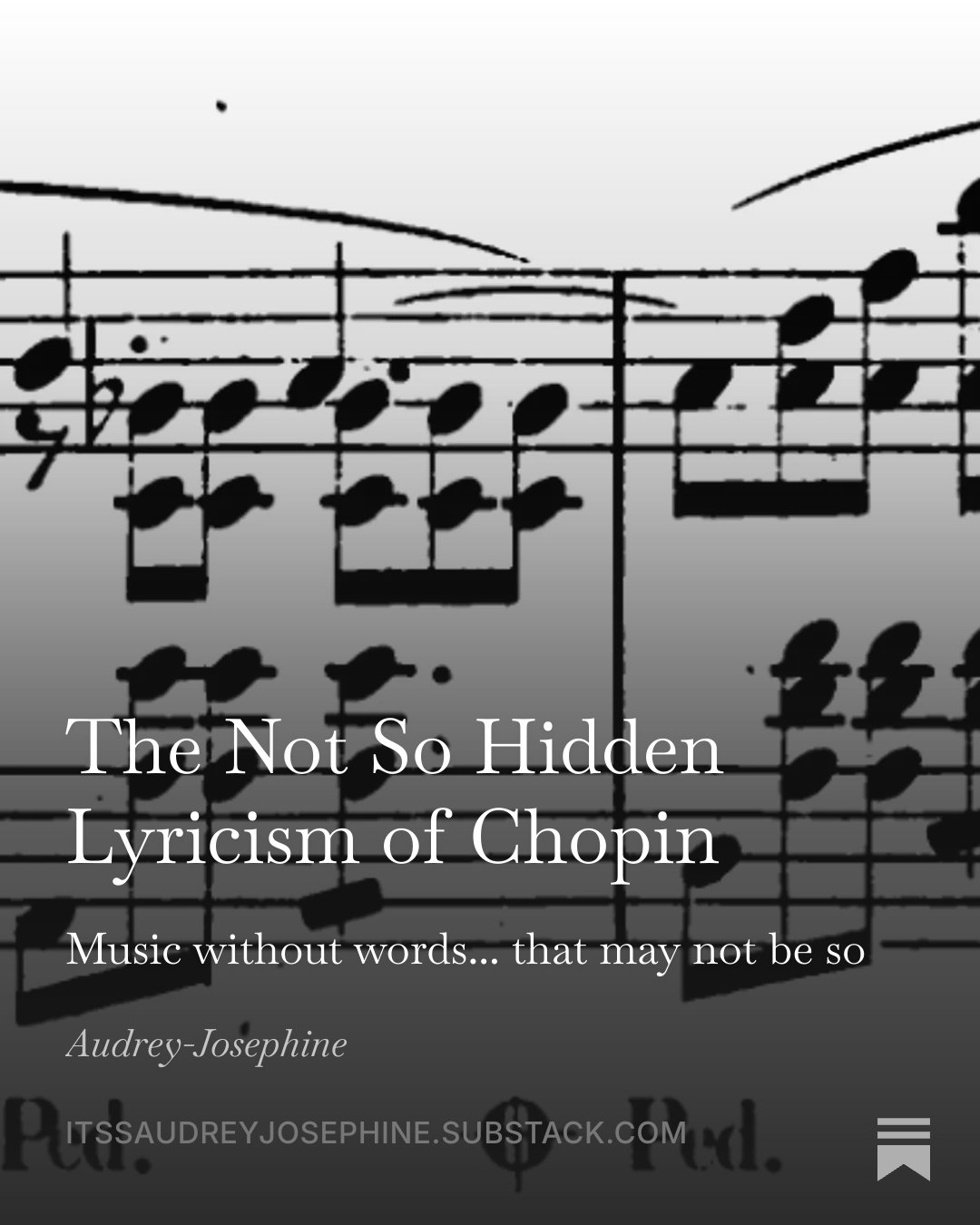
His Prelude in A flat major is one of the prime examples of an instrumental piece of classical music that very closely follows a song structure or form. Of course it is not strictly on the form, but let’s take a look.
Songs typically consist of a verse, pre-chorus, chorus, refrain, bridge and an outro. In modern pop music music of the 20th and 21st centuries, you can find variations on this format in almost every song. However today, there is an increasing amount of songs where these elements are missing or altered. For instance, the bridge.
Now Chopin composed his famous 24 preludes between the years 1835 to 1839. This is almost 200 years ago. So the song format was not of the same concept as we consider it today.
There’s something about this prelude in particular however, that makes it stand out in a lyrical and poetic sense. Of course classical music has songs, but piano pieces are not directly intended to be fully singable so to speak, but of course cantabile qualities can still be present.
The Opening = Intro/Pre-Chorus
The opening of the prelude could almost be the equivalent of a type of pre-chorus or intro, as it is the main theme, and it repeats itself throughout.
Check out the full article on my Substack